
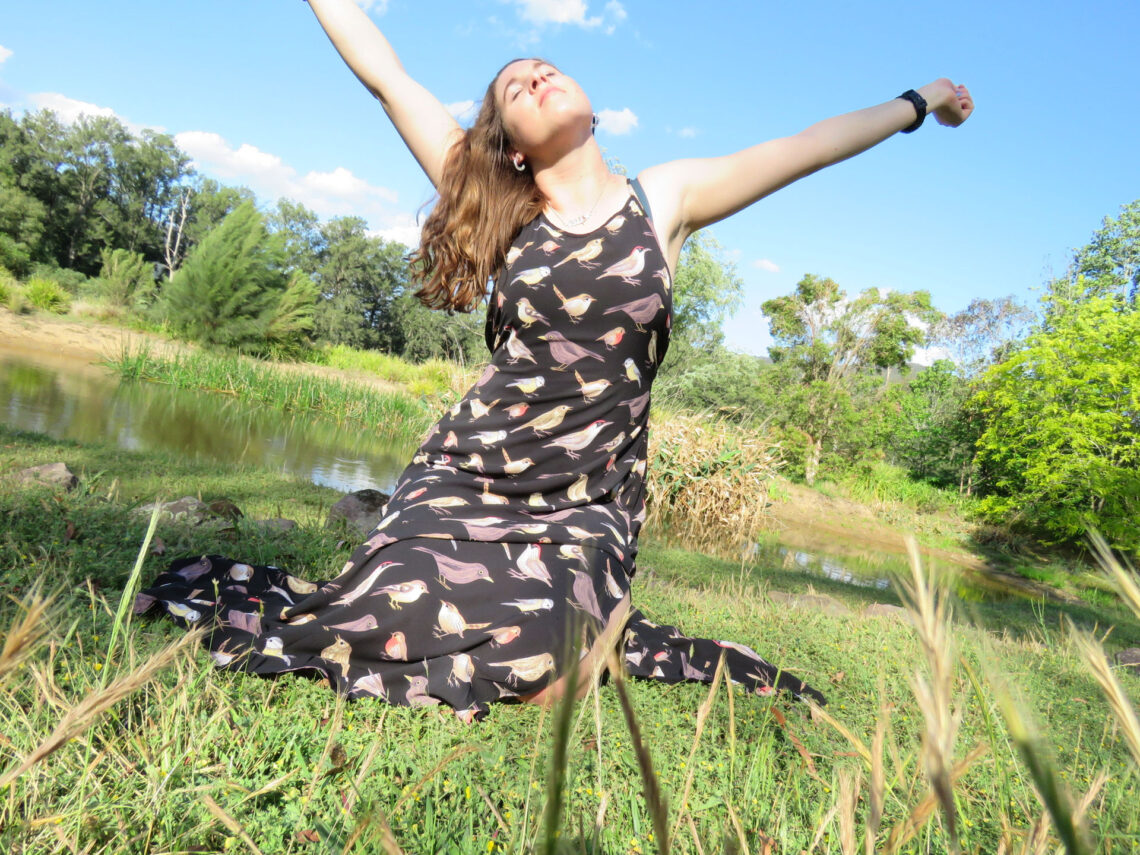
Dear Earth Carer, please don’t be mad, but I no longer identify as a Lonely Conservationist.
Dear Earth Carer,
It seems I have some explaining to do. But first, you should be reassured that the beloved site Lonely Conservationists and its associated social media are not going anywhere. In fact, if you send me a story about your life as a lonely conservationist, I will happily publish it. If you had your pitchfork and torch gripped tightly in closed fists whilst reading the title of this letter, feel free to slowly place them down beside you. It’s going to be okay.
My husband, Todd, warned me that some people may become mad about my shift in identity, but please be assured that this shift has nothing to do with the site or its importance or use within the World Wide Web and beyond. I wholeheartedly stand behind the amazing power of Lonely Conservationists as a platform, and all that it has achieved in awareness raising, building connections, and inspiring the need for change in many facets of the conservation sector, including the lives of conservationists themselves.
So what is this all about then?
It turns out it’s about many things. Everything, everywhere, all at once. It’s about my decolonisation journey, it’s about my current career happiness outside of the conservation industry, but also, and most importantly, it’s about how I feel.
You see, I have recently done something that I have never done before, and that is turning down an opportunity to speak to high school students. You may have guessed by now, but I usually relish the opportunity to speak to groups of individuals, especially young people. I was asked to talk about my early days in conservation and how the students could contribute to a better, brighter future for Mother Earth. I thought I loved to talk about my life experiences in the field, which is why it has been such a weird journey for me to have to delay this opportunity, and then eventually decide against doing it altogether.
You see, when I was preparing for this talk, I was feeling all sorts of feelings, the primary one being sick to my stomach. The first postponement was because I was just too physically ill to do the talk, my body repelling against it. When it happened again before the second date, I knew there was something more to explore here. What had this talk triggered in me to cause my body to react this way?
This year, many of my letters to you, dear Earth Carer, have detailed how I have found peace and contentment with my connection to Country, career, and self-care. In my reflections, I have come to see that this newfound happiness is a subtle signal pointing to the cause of my dread in preparing for the talk. You see, I feel safe and comfortable for the first time in, well, as long as I can remember, and how I felt thinking about this talk was akin to a bodily reaction that you might expect to feel after experiencing a traumatic event. According to my body, it’s all over; I have made it safely to the other side, and we should not, at any cost, look back over our shoulders to see what exploded. It’s just not what cool people do.
It’s no secret that my conservation career was riddled with exploitation, bullying, isolation, sexual abuse, feeling inadequate and burning myself out overcoming hurdle after hurdle. Yes, I have written and spoken about these things at nauseam, and have felt emboldened to do so for some time in the pursuit of change, no regrets there. It’s just that very suddenly, I have moved on. I don’t want talking about these hardships to be a side effect of living out the life I feel so privileged to be living. Even if I am not touching on the issues I faced, talking about my general experiences as a conservationist takes me back to these times. Times that I don’t wish to distress others with, much less scare them away from positive, hopeful pursuits in caring for our beautiful ecosystems.
Earlier in the year, I spoke to some university students about my tumultuous career journey since I first came to speak to the cohort in 2021. I viscerally remember driving home, deeply saddened that it seemed as if I had convinced the cohort to stay away from a life of environmentalism after openly sharing the challenges that I had faced in the past 5 years (amongst the wins, of course). One student shared with me that my experiences cemented their decision to commit to geology instead of environmental science; the environmental industry just didn’t seem worth the hassle.
This talk also made me realise that I haven’t worked in the conservation industry in the 7 years I have been working on Lonely Conservationists. Despite all of my efforts to advocate for the fair treatment of conservationists, in none of that time did I find a conservation organisation that would have me or that I felt could provide me with the pay or conditions that I’d be happy with. In good conscience, I couldn’t stand up in front of these high school students and recommend or influence a career in an industry that, despite my best efforts, would not have me. To do so would be setting these kids up for failure.
In many ways, Lonely Conservationists has converted my life hardships into repeatable anecdotes and my memories into curated stories. In every presentation or workshop, I have to take myself back to that place of loneliness and despair, to showcase the importance of care work and community that has since followed. As a result, Lonely Conservationists keeps me in the past. People refer to me as THE Lonely Conservationist, despite the fact that I am anything but lonely nowadays, and less affiliated with the conservation industry than ever.
Whilst navigating these inner feelings of survival and transition, I have also been grappling with how the conservation industry is not founded on principles that align with my values. No wonder we can’t all participate in the sector, when conservation often involves locking communities out of land to “protect” it. No wonder we have impostor syndrome, when we say that knowledge doesn?t exist when it is only held by people with generations-old knowledge, because a wealthy white scientist hasn’t officially declared it to be legitimate. No wonder we are so lonely when conservation is marketed as an opportunity for individuals to have the world on their shoulders and a spotlight shining down upon them in their heroic pursuits to save. If I seem fed up with these narratives, it’s because I am.
I recently read about John Gould again, a man with endless prestige, namesakes and novels written about him. He had Aboriginal friends who told him what all the wildlife was here in Australia, and he proceeded to discover this wildlife by listening to their rich knowledge and presenting it to wealthy white people. I would like to say that the nature sector has changed since, but I am not so sure. I was recently at a conference where a scientist was complaining that his control data was ruined by villages changing their fishing practices because they were seeing the benefits of the behaviour change interventions implemented in the neighbouring villages. They weren’t allowed to enjoy the fruits of sustainable fishing and coastal management practices that the other villages had because of the scientific method. I have obviously not been in the world of science for a while, because this sounded absolutely insane to me, and I have not stopped thinking about it since. I guess in our careers, we need to decide if we want to be a good scientist or someone who strives to do what it takes to improve coastal biodiversity and the lives of coastal communities.
For the past 7 years, I have been trying my best to carve out new norms for the world of conservation that better align with my inclusive, intersectional, and community-minded values. From the beginning of Lonely Conservationists, I have published and showcased the voices of many people from all corners of the globe, who all have diverse skills, knowledge, challenges, and abilities. I have advocated for community-based approaches, knowledge sharing, and giving others a leg up where we each can. I have tried to normalise advocating for ourselves against the entrenched monocultural systems, practising real self-care, and taking up seats at the table. Throughout all of that, nothing satisfied my pursuits of industry change; there were still so many people struggling to get into the industry and sustain their careers when they made it in. At an event earlier this year, a wise speaker talked about the need to start making new tables together instead of making space to sit at the pre-existing tables. This sentiment shifted something in me, and since then, I have realised that despite my best efforts to make this old table work for me, it is just not the table I want to sit at anymore.
Which brings us to this blog, Earth Carer Care. Earth Carer Care is my new table, and a table I hope that you will all find welcoming to sit at with me. At this table, I want to foster a replenishing and joyful care for Mother Earth, ourselves, and each other. I no longer consider myself to be a conservationist or a carer of just conservationists. Instead, I wish to open my larger-than-life table to all who take any steps to care for Earth in the bespoke ways that fill your cup and align with your skills. My table spans beyond sectors, wages, titles, interests and abilities. I hope we can sit around this table and share stories together, listen deeply, learn, change our minds, and practice care for ourselves and each other.
There is space at our table for people of all ages, including the spirits of our ancestors who gave us the knowledge we have now, and the children yet to be born in all of their curiosities. The latter of which, many of us are working so hard to gift a livable world to. There is space at our table for those who do nothing of great benefit for our world, but may want to give it a try. There is space at our table for the weary activists who stand for so many more people than themselves on the front line. There is space at our table for the whimsical and the creatives who share valuable information using more than alphabets and numbers, and the serious among us who rein us in and hold us accountable for our promises. The table slopes and rises to adjust for those of all heights, statures, and mobility, is free to sit at, and can be sat at from anywhere in the world. We speak in all languages at this table, including the poignant silence that speaks volumes, and the raucous laughter that is inherently understood by all. As long as you care about caring for our natural world and the people who live here, there is a spot at the table waiting for you.
I don’t know what I am yet in terms of a snazzy defining label, what my bio will say, or how people will introduce me to others. I am sure to many, I will forever be the Lonely Conservationist, and to others, I will just be Jessie. But this isn’t a transition for others; this, my dear Earth Carer, isn’t even a transition for you. This is the shedding of a much too-tight skin, a morphing into a new form that better suits my environment and the resources I have aplenty. In my new form, I feel invigorated by the opportunities and people I may encounter along my journey, knowing that often, riding the undulating twists and turns along the way is more gratifying than any destination could ever be. I must have been born from a uterus filled with flat stones, because I am no stranger to paving the way where there is no path.
So into a blazing fire conjured by my imagination, surrounded by dense forest and a glittery starry sky, I thrust forward the label Lonely Conservationist and feel freed, knowing that, title or not, I still have a pretty good table to sit at with all of you.
I look forward to our next dinner party together at our new table,
Jessie


2 Comments
Pingback:
Jason
I feel the same anger. After your story on the Mongabay podcast, someone commented that we shouldn’t refer to conservation as an “industry,” because industry is inherently capitalistic and extractive. But isn’t that just the point you are making by calling it that? The point — the problem — is that conservation is an industry.