Dear Earth Carer, truth telling needs to be business as usual.
Dear Earth Carer,
A few years ago, I sat in my climate-aware therapist’s room and I asked her if she thought I was autistic.
“Would it impact your life in any way if you were?” she asked.
“No, but people keep telling me I am,” I replied.
“Then it doesn’t matter.” She said.
Living with a neurodivergent human and understanding how fundamentally his brain differs from mine, I believe that I am neurotypical with a strong sense of justice, honesty, and integrity. My feeling is that people like to tell me that I am autistic when my honesty, sense of justice, or integrity makes them uncomfortable. This, I feel, is not fair to people who are diagnosed with autism, as autism is not a sweep of attributes and behaviours designed to make others uncomfortable.
I, like many other young whipper snappers back in the day, was extraordinarily black and white. I would write heated essays at school describing the ruthless murder of our cousins, the orange men of the forest, for the sake of monoculture oil crops. This was not taken too lightly by my teacher, who suggested that a more objective lens was needed. Even back in year 9, I sensed that the urgency and need for care was being dismissed for an arbitrary notion of formality. Objectively, the lives of orangutans were casualties in the supply chain of oil palm plantations; there was just more to the story. There were human rights issues that I was neglecting, blinded by the wrong that humans were doing to nature and forgetting their own need for employment and survival. Even if I had a well-rounded view back then, to this day, I still believe that we should not be taught to suppress our care for or mute the pain and suffering of others, though it is convenient for everyone that we do so.
As we get older, society tries so hard to even us out, and it starts to become culturally insensitive to point out stark truths like we could when we are young and assumed to not know any better. When I was 18, I walked up to a Malaysian embassy representative at a palm oil conference and asked him if he really thought that Malaysia was undergoing significant reforestation efforts when all they had to show for it was a map detailing a thin corridor planted to conjoin two fragments.
“Look! More trees!” They said.
The person hosting me at the conference informed me that I only got away with that interaction because of how young I was.
“What do you mean?” I asked. “I thought we were here to make change.”
In my eyes, a small corridor wasn’t enough to rectify the hectares and hectares of land lost to plantations.
Though I now see all the plentiful shades of grey between the stark blacks and whites of the world, I am still confused about the lack of justice that exists as a result of a severe lack of much-needed truth-telling. As an example of this, in 2023, we, as an Australian nation, voted against the Voice to Parliament, a law proposed to alter the constitution to recognise the First Peoples of Australia by establishing an Aboriginal and Torres Strait Islander Voice. That’s it, just a voice, an opportunity to be heard. The people of Australia were blasted with campaigns stating that if you don’t know, you should vote no. Literally, stay ignorant and silence others. And that’s exactly what Australia did.
Recently, I stood amongst the graves on Coranderrk Station, a station created in 1863 by Wurundjeri peoples of the Kulin Nation as a way to be housed, keep together, and stay alive in a world that wasn’t friendly (understatement of the century) to them. I encourage you to watch First Australians if you haven’t already, as the history of Coranderrk is shared in episode 3, Freedom For Our Lifetime. It is a story about self-determination, assimilation, and ultimately betrayal at the hands of the Victorian government. We giveth and we taketh away. No hospitals for you! Suffer in your jocks, as my dad likes to say.
Despite the fierce Wurundjeri leaders that Coranderrk had in William Barak and Simon Wonga, I stood amongst those graves, thinking about how 160 years later, the power imbalance was still power imbalancing. I am completely aware that some Indigenous peoples voted no to the Voice and that there are more complexities than I describe here; however, why is this even something we (non-Indigenous peoples) were voting for, and why was our nation so okay with being told to stay ignorant? That decision hurt many and also said much about history and the way it likes to repeat itself. As I stood out on Country and looked across the land, I thought about how much power I have, and so many of us have, in our abilities to vote on the livelihoods and futures of Indigenous peoples, immigrants, poor people, and people with disabilities. Why do I have this undeserved power, and why are the perspectives and experiences of these peoples so silenced when we are expected to make decisions about their health and well-being? More so, why are we not encouraged to seek these experiences and perspectives out? I know why, it’s that damn power imbalance again, isn’t it? I often feel embarrassed to live in such a purposefully ignorant country, and know that after the vote and the recent immigration protests, many others do too.
Last year, a colleague sent me a checklist of things to ask yourself before researching on islands in and around Scotland and Ireland. The first question was “Am I the right person to be doing this research?” and I think about this a lot. What if throughout history, people asked themselves, “Am I the right person to be doing this?” Imagine how different our lives would be. So now I like to write my own history and ask myself the same question as I walk through life. “Am I the right person to be saying this, getting this opportunity, sitting at the table, or doing this work?” If the answer is no, then who is the right person? Let me find them.
Someone once said that learning is a smart person’s way of procrastinating and that we need to stop reading and just start doing. But I have to disagree. The more we listen, learn, empathise, and care, the better our world will be. History tells many stories of those who do without thought or care for others; in fact, these stories make up the foundation of much of what we see in society today. Racing ahead and leaving others behind may get you where you want to go faster, but it will also get you there alone, and as you know, I have denounced my loneliness once and for all. Maybe if you ask the right questions and listen to the right people, you may learn that if you hadn’t done so, you’d be racing to the wrong finish line. You’d get there quickly, but end up in a place you don’t really want to be.
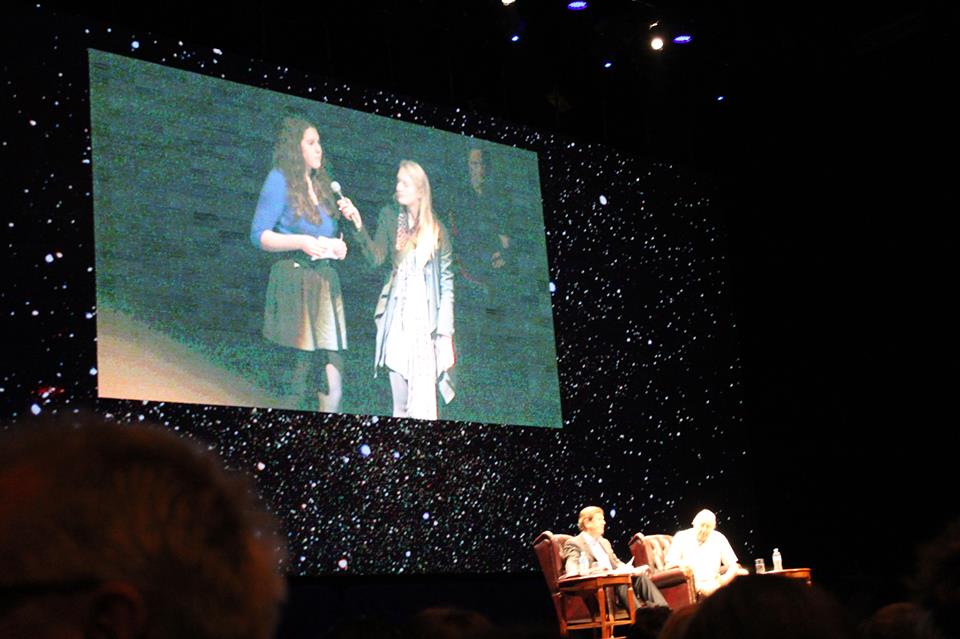
You might be wondering about the image I chose to use for this letter, and yes, that is me on the big screen asking a question to Sir David Attenborough, sitting next to beloved Australian journalist Ray Martin in the foreground. That night, on his tour in my hometown of Adelaide over a decade ago, the audience was able to submit questions, and I didn’t hold back. I asked Sir David how he feels about being a conservation icon, considering he took so many wild animals from their native habitats in his former years. At the time, my research of bigwig naturalists like Darwin, Wallace, and Gould involved reading about a lot of shooting, collecting, and taking. Though science valued their immense contributions, I’d not be able to sit with myself knowing the damage I’d caused had I built a similar career for myself. I approached my question with genuine curiosity and intrigue.
Despite my pointed question, it was one of the four audience questions chosen, and to his credit, Attenborough talked freely about his questionable past rather than being shamed away from it. Attenborough admitted that although taking animals from their habitats might not have been the best time for wild populations, he acknowledges that his advocacy for nature since has most likely led him to more than make up for it. This interaction showed me that it was okay to ask hard questions and important to talk about challenging topics with grace and dignity. Attenborough wasn’t promoting his former behaviours of the past or explaining them away; it was what it was, and he has done the best he can for wildlife since.
Like Attenborough did that day, I think we need to start curating an environment that’s safe enough to admit our bumps in the road, our stumbles, and our falls. These things that we are doing, supporting fossil fuels, consuming rapidly, farming monocultures, these are all behaviours that we can stop. We can move forward, look back and talk about knowing and doing better now. We can even make excited comments about how our impact is starting to outweigh our damage. For that though, we need a culture that supports change, growth, and learning. We need leaders who acknowledge that it’s okay to cut our losses and start anew. It’s okay to fail and learn in pursuit of something better. Good culture often starts from the top, a place where it is seldom found.
This is not to discount our own roles in contributing to this safe and honest vision of the future. Regardless of knowing our influence, I think we all have an important role to play in truth-telling. Almost nobody reading this letter knew who I was in January of 2019 when I decided to be honest about my experiences in the conservation industry. That didn’t matter, though, did it? You never know how much others need to hear what’s never said but often felt. Though you may find it challenging to be honest about difficult experiences, there’s a vital sense of camaraderie that comes from a me too. Two people experiencing something together, but in their own flavour, is a stark reminder that each individual is no longer alone. In that togetherness exists a power in numbers that can be harnessed to overcome existing and new challenges, a power that lies invisible and untapped in the isolation of a solitary experience.
Sometimes I think about all of the people who have died in their truth-telling pursuits: journalists, victims of abuse, reformed members of extreme religious communities, and activists, to name a few. To these people, honesty wasn’t just a trivial choice; it was the difference between their lives and the lives of many others that they chose to speak up for. Imagine how monumental their words were if scared, but ultimately powerful people went to such lengths to silence them. If something isn’t freely said, what power is that silence protecting? Do we want to participate in safeguarding that power? These are the questions we must ask, especially considering how most of us can choose honesty without sacrificing our lives as a result of that choice. In the words of one of my favourite childhood movies, Big Fat Liar, the truth is not overrated.
When people suggest that I may be autistic, it makes me wonder about our society. If honesty, a strong sense of justice, and integrity are attributes confined to those labelled with a disorder, syndrome, or condition (different sources use different terminologies), I really think we have a lot to think about. If the exception to the rule is children, this also may explain why I get perceived to be way younger than I am most of the time. The thing is, I am old enough to know better, and to me, knowing better is wanting justice for all and pointing out when something isn’t quite right. Knowing better is knowing that we don’t have to suffer alone in the face of difficult experiences. There’s no world in which knowing better equals staying silent, especially when staying silent only leaves victims feeling isolated, misunderstood, and without power, all the while gifting the oppressors with a wonderful sense of control. If you ask me, I think that children and individuals with autism may know better than any person who has ever suggested that we should know better than to speak up. As a culture, we can either stay ignorant or we can know better, and maybe one day the powers that be will realise their hypocrisy and that they need to choose just one mantra and stick with it. We cannot do both.
So here’s to all of our truths, may we keep spitting them.
Jessie


You May Also Like
Dear Earth Carer, your thirst for optimisation may be impacting your sustainability.
I wish people remembered- an ode to caring for ourselves like nature does.