Dear conservationist, a brood parasite restored my faith in humanity.
Dear conservationist,
I started this year by reading “Human Kind, a Hopeful History” as I wanted this year to be different. I think, like many conservationists, I have often grappled with the notion that people need to be better for the world to be better. I wanted to challenge my thinking and try to internalise the notion that people are already inherently good- as is backed by science and the lived experiences of many. I would encourage everyone and anyone to read this book. The news, media, and general vibe of society, love to suggest that humans are the absolute worst, but it’s a self-fulfilling prophecy. The more we harp on about how bad we all are, the more we play into that stereotype as a response. So as my contribution to changing the narrative, I wish to share with you all my recent experience of having my faith in humanity restored by none other than a brood parasite.
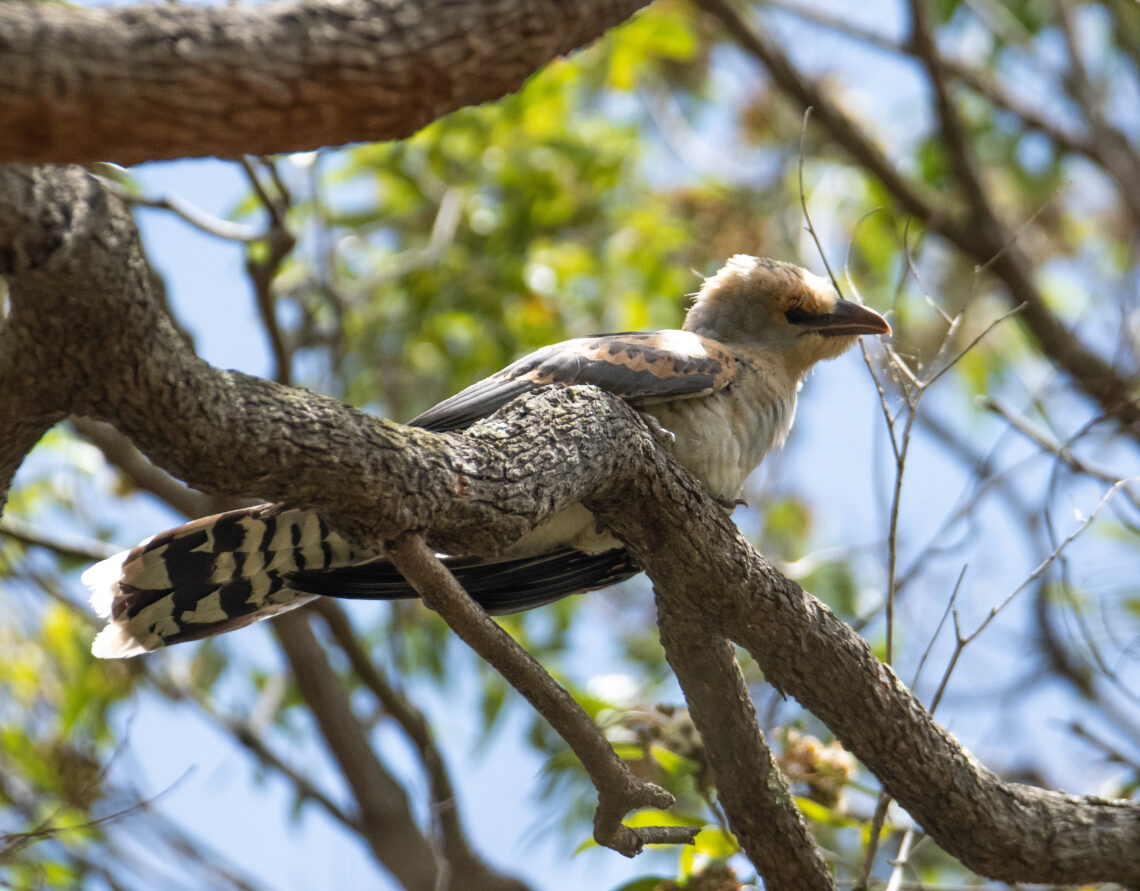
If you’re a fellow birder living in Melbourne, you probably know of the channel-billed cuckoos that are currently swindling the ravens of the North Eastern Suburbs. If you have no idea what I’m talking about, channel-billed cuckoos are the largest brood parasite in the world, meaning, they are hefty in size and the mother cuckoo will lay her eggs in the unsuspecting nest of another bird to raise her young for her. Why is this cuckoo taking Melbourne by storm you ask? Well, you see, channel-billed cuckoos are native to Indonesia and Papua New Guinea and trek down to Australia around October each year- but they usually only get as far south as Sydney. In Melbourne, this cuckoo is a rare fly-in.
When I first learnt that this cuckoo was living close by to me, I didn’t even take my camera when I went to hunt it down. The thing is, usually when there is a bird I am supposed to see- it’s hard to find and I end up disappointed and birdless at the end of the day. Taking my camera would probably jinx my ability to see it. Luckily for me, this cuckoo was an exception; in fact, it was the easiest lifer (new bird) I have ever found. Here is how easy it was:
- I saw my friend’s Instagram post of the cuckoo with the geotag listed as the neighbouring suburb to mine
- I messaged my friend to find the actual location
- I walked for 10 minutes during my lunch break
- I saw a birder with her camera pointing at the tree
- I heard raucous screaming
- Wallah! A cuckoo!
Not only was the cuckoo easy to see and hear, but there were so many birders hanging around who were eager to tell me about what the cuckoos had been up to. Having found out that they had been there for the week, I decided they’d probably still be swindling ravens when I was able to return with my camera later that evening.
That evening after a 12-hour workday, I drag my husband, Todd, to the park to see the cuckoo. He was proud of himself because, despite not being a birder, he was able to find the cuckoo from its raucous screams before I did. Looking up into the tree, a man and his son drove by. This was before my faith in humanity was restored, so when they wound down the window to ask what we were looking at, I just said “A bird.” You see, I assumed that they didn’t care about the cuckoo. The man wound the window back up and drove away.
Human Kind, a Hopeful History, talks about the concept of a nocebo. You have most likely heard of a placebo, where good can come from a pretend treatment. A nocebo is the opposite, it’s where harm can occur from a treatment where it is perceived to cause damage. Because of what I assumed about this man, I nocebo’d the outcome. I assumed he wouldn’t care about the cuckoo, which, in turn, caused him not to care because I didn’t give him the chance. How many times do we do this in our lifetimes? I hate to think how much I, an environmental educator of all things, manifest disinterest or apathy because of my assumptions that others don’t care as much as I do. Western society continually reinforces that other people are worse than we are through negative news stories and media and we are taking these narratives and reinforcing them, perpetuating the problem. Now I know about it, I have immediately caught myself doing it.
The man who immediately made me regret the error of my ways was a golfer. I was standing with Todd and two other birders, watching the ravens feed the cuckoos in the middle of the neighbouring golf course when a golfer approached us. Myself and the other woman in the group noticed that he had his club firmly gripped by his side, we were alert and wary. The men just thought that this was part and parcel of being a golfer. Our group assumed he was approaching to ask us to get off the green, but once he reached us, he asked if we were birders.
“How did you guess?!” I Joked. You can understand the joke for yourself if you imagine 4 people clad with binoculars and telescopic lenses. I know it’s not cool to explain jokes, but I am assuming not all of my letter recipients are birders- yet.
Upon approaching us, the golfer proceeded to get out his phone and show us pictures of all the wildlife he had seen around the golf course in his time, including a range of bird species. He even showed us pictures of the juvenile tawny frogmouths perched fluffily in his mum’s yard nearby. He eventually left, only to return to let us know of a pigeon that landed where he was golfing. He said it was a wood pigeon- which isn’t a thing here, but I am assuming he meant the fabulously metallic common bronzewing or the punk rocker crested pigeon.
I was struck by the golfer’s enthusiasm. Firstly, because he had challenged our assumptions, but secondly, because I often come to parks adjacent to golf courses to see wildlife, but I never gave a moment’s thought to the fact that golfers could be enjoying the wildlife themselves. Golf courses are a bit of an environmental nightmare associated with wealthy people and business deals- but they are also a large expanse of trees and greenery that many people spend a lot of time on. I appreciated this man for challenging my assumptions. Maybe the man in the car would care about a rare cuckoo after all.
Over the proceeding days, I would have many conversations with golfers as I stood neighbouring the green, looking up into trees. When they asked, I told them all exactly what I was looking at, why there were so many birders gathering, and why it was so exciting. I even told them to look out for the ravens feeding them for some added excitement. Every time, the golfers were interested, asked questions, and tried to catch a glimpse of the bird for themselves. No more nocebos, I thought. If I want to be the change I want to see, I can’t be inadvertently spreading apathy and disinterest because I assume people don’t care about what I care about. I need to give people the opportunity to decide for themselves.
The golfers were one aspect of my faith in humanity returning, but the major contributor was the birders themselves. That first night with Todd, we met two other birders who we got along with really well. After our conversation with the first golfer, we stayed out together by the light of our phone torches until 10:30 pm, laughing and looking for night-time critters in the park. I showed them my favourite tree, which immediately boasted a brushtail possum and a tawny frogmouth (not paid actors), and we even found a frog, moments after one of them said they had never seen one in the wild and had always wanted to. We have been in touch ever since.
I met another bunch of birders yesterday, one of which knew someone with a powerful owl in their backyard. If you have talked to me for any length of time, you probably know that I have spent the past 7 years trying to find a powerful owl (the largest Australian owl) to no avail. I have been to countless GPS locations, endured injuries, and have even had a past workplace have a standing item in the team meeting, every week checking if I had found it yet. I got this man’s details and he suggested we try trading a bottle of wine for a glimpse into his friend’s backyard. He also messaged me yesterday with some de-noising technology after I shared that my dusk pictures came out grainy.
For the past week, I have been able to find instant kin at my local park. People are excited to tell me the whereabouts of the cuckoo, share what antics they have been up to, and ask curious questions. Many a birdstagram has been shared, and new friendships formed. Even conversations with the golfers have sparked conversations about why the cuckoos might be this south, with individuals sharing their observations about the changing weather conditions over the years and how this may be a contributing factor.
The thing is, every bird is as interesting as this cuckoo in its own way, and I bet I have a fun fact for most of the birds I see. What’s stopping me from bringing this enthusiasm to every conversation where someone stops me in my tracks to ask what I’m looking at? Yes, rainbow lorikeets are beautiful – but did you know they are the most common bird in Australia? Even more common than seagulls or pigeons! Did you know that Australian magpies are just named after British magpies, but ours aren’t even corvid (really intelligent) birds? They are just a humble relative of the butcherbird- which, did you know butchers mice and lays out their innards on tree branches, giving them their names?
No longer am I going to tell people, I’m looking at “just a bird.” Even if it is a pigeon. I choose not to be an apathy vector anymore!
Starting this year has felt a lot different to the start of many other years. I came into it seeking to be hopeful, and immediately I found hope. Maybe we conservationists are so lonely because we assume we are the only ones who care about our natural world, but how would our lives change if we assumed that everyone cared? Excitement is contagious and if I saw someone losing their mind over an ant, I may well assume that it was a special ant that I should get excited about too.
I am sorry to the ravens, but I need to thank the channel-billed cuckoos for coming to visit. They might be assholes, but regardless, they have made my 2025 the most hopeful year yet.
Please tell me if you do actually have a favourite ant,
Jessie


You May Also Like
Dear conservationist, I know you’re exhausted
Why is a deficit mindset so common in conservationists and how can we learn to find abundance?