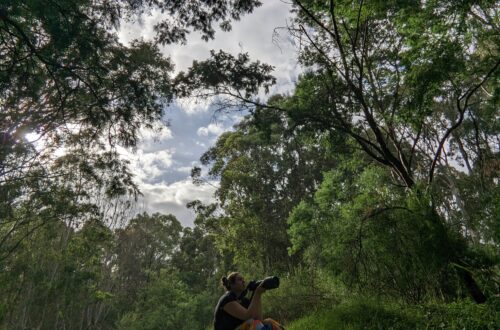
Dear Earth Carer, there is a life for you beyond ecogrief.
Dear Earth Carer,
As I prepare to embark on a journey to yet another island ecosystem, I am finding myself thinking back to the last time I needed to retreat to an island refuge. The last time was an essential life-saving mission to bring me out of the depths of ecogrief and remind me why my connection to the natural world is so important. I needed to remember that beyond the destruction, there is so much beauty and diversity still out there, and so much resilience and adaptation to be found. I am proud to say that the beacons of hope that I found on that island are still effective in keeping the grief away for me now, two years later. Sometimes we uncover a piece of wisdom or a slice of light that feels poignant in the moment, but after a while, we forget it’s significance. In my case, ecogrief is something that threatens to knock at my door every day while working in climate action, talking to conservationists in my community, or when hearing the news. By keeping a practice of intentionality towards my mental wellbeing, I have been able to remember that I can contribute more to making the world a better place when I am not in the foetal position bawling my eyes out. Thankfully, this upcoming visit to an island comes not as a crisis mitigation, but much rather a pit stop to check my oil, change my tyres, and make sure I can keep operating as I should.
My dear Earth Carer, do you have an ecosystem that recharges your battery? For me, islands are the cables that allow me to recharge wholly and completely. They can be cold, windswept islands, like those you’d find on Scottish shores, or the tropical sandy islands found around the Earth’s waistline. There is something so wise about a mass of land that has been created, unveiled, or segregated, and left to its own devices to home a truly unique assortment of life. Islands know what it’s like to be lonely, or to be a part of a communal archipelago. Islands know how to birth life from scratch and how, in time, to die with dignity. Islands know the wisdom that a surge in production can’t last forever, and that eventually you must chill out and manage your capacity. Islands can be the most hostile or the most chill, the most desolate or the most abundant, the oldest or the youngest. My love for islands feels deeply primal, like it’s etched into my DNA, but maybe my love for islands is an affliction born from my ecological roots. After all, islands were always the hubs of evolutionary history, from the Galapagos to the many islands that make up Indonesia; Darwin and Wallace’s history is tied to these places. Likewise, my history feels tied to them, too.
One inhabitant of many of the islands that I visit are geckos. Geckos are the truest Pokémon, and I will never forget the first time I heard them sing their own name, GECK- KO, in the South Australian bush in my early twenties. Though large, Australia is itself an island full of weird and wonderful creatures. It turns out that in my former grief, I desperately needed to hear geckos sing, as they have sung their way through different chapters of my life. They sang me through my volunteer stints across Australia and Thailand, my first job in Madagascar, and my honours in Indonesia. Sitting on the shore of a Fijian beach, listening to the geckos chirp as the sun set, welcoming in the evening, I felt a moment of poignancy as I realised that geckos were the true soundtrack of my environmental journey throughout the years. In their chirping, the geckos reminded me that I am still on the same path, and though my geography, career, stage of life, and emotions may undulate through time, no matter what, the inevitable throughline of it all is that the geckos and I will reunite for time immemorial. This brought me comfort. Thats one thing I love about islands, feeling as though I am existing in an aside of my life. Sitting in the middle of what feels like nowhere, listening to the wisdom of geckos and having them put everything into perspective for me.
For most of my life, I have been obsessed with forging a linear path for myself, only to feel the devastation creep in when I would be thrown off course through stormy seas, constantly needing to re-route and adjust my sails. Maybe geckos are the messengers of island ecosystems, because through their familiar chirps, they informed me that no matter what I was doing on these island refuges, from working to volunteering, or just healing and taking leisure time for myself, that I am on the right path. I believe that many environmentalists, but especially conservationists, feel their career to be so tightly entwined with their identity, so uncoupling my path from my career has been healing. It turns out that the destruction of the natural world is not a reflection of my personal career failings, or even the failings of all of our careers combined. Environmentalists can do all the right things and work until we are blue in the face, but a large oil spill, natural disaster, or billionaire’s swift decision can undo a lifetime of effort. My path, being more entwined with my values and love for nature, feels kinder to myself than an enmeshment with my job. In the prime of my conservation career, there were geckos, and they were still there when I had left the industry and was seeking solace from the destruction of it all. Throughout all of these times, I was choosing to surround myself with the places that I love, all the while, caring for myself and Country in the ways I knew how. Since the geckos have shown me my true path, it’s been harder for grief to find me.
Crabs, as you may likely know from my previous musings, have also been strong anchors for me to stay out of grief. Earlier this year, I had a hermit crab tattooed on my left arm so that I could use it as a visual reminder of the abundance, diversity, and tenacity of organisms that are still prevalent in our natural world. Have you ever heard about the evolutionary tendency for every organism to want to evolve into a crab? Crabs have honed their body plan over millenia and it is near perfect. My little arm hermit has been a great tool in anchoring myself out of grief, because in times where I am overcome with the notion of destruction, negligence, and pollution, I just need to look at the hermit to remember how amazing it is that, despite all that we have done, many creatures still persist. My arm hermit has a shell that it can hide away and seek refuge in when needed, and to protect against whatever may come. Hermit shells aren’t fixed, so they can grow out of them and change them up, they can swap with others, and adapt differently in each stage of their lives. Because of the shell diversity, no two hermits will look the same, and that is a testament to their unique adaptability, too. I remember back to sitting on a crisp white shore and seeing a vast diversity of crustacean life, despite the reefs wrecked by cruise boats that lay hidden by the shallows only meters away. Despite all, the crabs still prospered. The world is not ending as long as the crabs are scuttling. Crabs are still my very tangible anchor out of ecogrief, and they have guided me towards joy in ways I never could have imagined.
If you can remember back to my previous letters, aside from crabs, the other beacon of hope that pulled me out of my grief was the notion that Earth takes care of us back. Reciprocity, true reciprocity, is important for survival. Not tit for tat, but genuine connection, being in relation to community and Country, giving and taking when needed. For so long, my environmental pursuits felt as if the aim of the game was to give and fight until I resembled a depleted husk of a person. As someone with ecological training, I should be embarrassed about this. Thriving ecosystems don’t thrive because their elements are isolated and out of balance with others. Trees don’t selflessly give us shade, oxygen and nutritious fruits without first receiving sunlight, healthy soil, and water. Since sitting with this care from nature, I have made a more intentional effort to put myself in relation to others and my environment. I have learnt the value of asking for what I need, advocating and prioritising my life-giving elements- my soil, my nutrients, my water. I have also learned to find out how others around me best receive care. Some plants are dry with yellow, crispy leaves, and others are waterlogged with rotting roots, so caring for all the plants by getting out my watering can and giving them each the same sprinkle of water was not conducive to providing the same care to them all. In some cases, it was making things worse. If each person in my life is a house plant, I hope that my spaces continue to flourish with rich green, thriving foliage.
Through being more intentional in my relationships with others and with Country, I have come to learn the most valuable lesson of all, one that has transitioned my 2024 grief into my 2025 and 2026 contentedness. This realisation has changed everything. I went from not seeing any hope for the future to having the best year of my life just months later. What I realised is that the most important work that I do for our planet is never listed on a position description or found in a job title. The connections I make, the cultures I shift, and the time that I spend appreciating the people, places, and natural world around me- these are the truly important tasks in crafting a better world. The geckos were right in that it’s not a linear path of career growth that keeps me steady, it’s staying true to my values, and being the change I want to see in every moment. Making the world a better place isn’t about working conservation jobs and getting burnt out in regular cycles, but it’s about connecting beyond silos in any job I do, and working across teams to make sustainability truly intersectional and institutionally embedded. It’s about getting to know my colleagues as real, multifaceted people so that we can support each other as human beings. It’s about taking small moments in my life to stop and notice the patterns of bark, glistening morning spiderwebs, and the diversity of fungi in my damp Autumn strolls. It’s about listening instead of jumping to solve problems, advocating for those around me to succeed, and sharing resources where possible. It’s gently collaborating on projects with people I love, and finding joy in creating together. All of these small, cumulative acts have tangibly made my world a better place and have created a more connected foundation in which to tackle loftier environmental projects together.
Making all of these discoveries on an island two years ago has fundamentally revolutionised my life. In spending time listening to the wisdom of the geckos, observing the tenacity of the crabs, and placing myself truly in relation to Country and it’s people, the island gave me the antidote for grief. Alignment with my values, remembering what thrives, and connecting to people and places in true reciprocity has kept the grief at bay ever since. For some, it may be the winter snow that tells you these stories in the ways in which you need to hear them, or the thrashing waves of the ocean. Maybe it’s the small urban gardens or giant encompassing forests. Whichever ecosystem is etched into your DNA, go and sit with it. Take the time to listen to its wisdom if grief is tapping you on the shoulder, enticing you to slip into its suffocating grasp.
Thinking back to my last island experience, wandering alone and seeking answers, my upcoming trip could not be more different. I wish I could tell my past self that she needs to keep going, because if she pushes through the pit of her grief, she will become the Earth Carer that she has always dreamed of being. She will meet someone whilst looking for a bird, and that person will be as excited about the ocean and the land as she is. She will invite this person to her dream, bucket-list island in pursuit of surrounding herself with crabs of all shapes and sizes, and they will enthusiastically agree to join her. She will spend months getting so excited to travel together with this new friend, and they will find joy in envisioning and planning their adventures together. She will look at the hermit upon her arm, and feel grateful for the life that all the crabs like it have inspired for her. Instead of fear for the future, she understands so tangibly how she and others around her can make the world a beautiful place to live. More than happy, she is content, a feeling she never thought she could be as an environmentalist, and yet she is so.
My dear Earth Carer, I’m now wondering what the throughline of your journey is. It can’t be geckos for us all, can it? It’s funny to think about all the resources out there relating to caring for ourselves, wellness, and mental health, and not one of them tells us to speak to a gecko or hang out with a crab- until my letters, that is. All this to say that grief takes many forms, as does healing from it. The thing about ecogrief, though, is that it’s probably never to be resolved by capitalist fixes, as these will just add to the lamentation of the systems at play. In this regard, speaking to geckos seems like one of the most appropriate measures in times of environmental concern. Whatever your throughline is and whatever your beacons of hope are, I hope they find you soon. You deserve a future that you can enjoy, after all, you have worked hard to hold on to a natural world worthy of playing in.
Crabbily yours,
Jessie


You May Also Like
Why is a deficit mindset so common in conservationists and how can we learn to find abundance?
Dear conservationist, your worth is not resting in the hands of your potential employers.